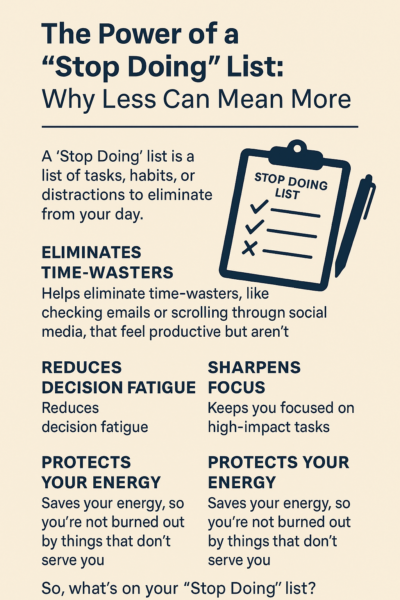
 The Power of a “Stop Doing” List:
Why Less Can Mean More
We live in a world that glorifies busyness.
Productivity is often measured by how much we can cram into a day,
How many tasks we tick off, or how many hours we spend hustling.
But here’s a simple truth:
Being productive isn’t about doing more—it’s about doing the right things.
And sometimes, the best way to boost productivity isn’t by adding more to your plate,
But by cutting out what’s holding you back.
Enter the “Stop Doing” List
Most of us are familiar with the classic to-do list.
It’s the backbone of productivity systems everywhere.
But there’s another list that’s just as important—
Maybe even more powerful—the Stop Doing list.
A Stop Doing list is a conscious inventory of tasks, habits, or distractions that drain your time and energy.
These are the things that masquerade as productive but don’t actually move you closer to your goals.
Think of it as decluttering your schedule the same way you’d declutter a messy room.
Why You Need a Stop Doing List
Here’s what makes this tool so effective:
-
Eliminates time-wasters: Checking emails every 10 minutes, scrolling social media, or attending meetings without clear agendas might feel busy, but they rarely create meaningful progress.
-
Reduces decision fatigue: Every choice you make consumes mental energy. By removing low-value tasks, you free up brainpower for the decisions that matter.
-
Sharpens focus: With fewer distractions, you can zero in on high-impact work—the kind that actually moves the needle.
-
Protects your energy: Burnout often comes from spending too much time on things that don’t serve you. Cutting them out preserves your stamina for what truly matters.
-
Creates space for growth: By letting go of what holds you back, you open up room for new opportunities, projects, and habits that align with your goals.
How to Build Your Own Stop Doing List
The beauty of this list is that it’s customizable.
What drains one person might energize another.
The key is to identify what’s getting in the way of your goals.
Here are a few steps to get started:
-
Audit your day: Track how you spend your time for a week. Notice patterns of distraction or low-value activities.
-
Spot the culprits: Highlight tasks that don’t contribute to your goals or leave you feeling drained.
-
Be ruthless: Ask yourself, If I stopped doing this, would it really matter? If the answer is no, it belongs on the list.
-
Replace with intention: Once you cut something out, consider what you’ll do with the freed-up time. Maybe it’s deep work, rest, or learning something new.
Examples of What Might Go on Your List
-
Constantly refreshing your inbox
-
Saying “yes” to every request
-
Multitasking instead of focusing deeply
-
Consuming endless news or social feeds
-
Attending meetings without clear purpose
-
Overthinking small decisions
The Bottom Line
Productivity isn’t about squeezing more into your day—
It’s about making space for what matters most.
A Stop Doing list is a powerful way to reclaim your time, energy, and focus.
By cutting out the noise, you create room for clarity, creativity, and growth.
So, what’s on your Stop Doing list?
Take a moment to reflect, write it down, and watch how much more focused and productive you become once you let go of what doesn’t move you forward.